What Is a Lash Lift and Tint? Here’s the Real Scoop
What Is a Lash Lift and Tint? Benefits, Process & Results Elleebana Team India If...
Read More 
Science-Backed, Precision-Lifted
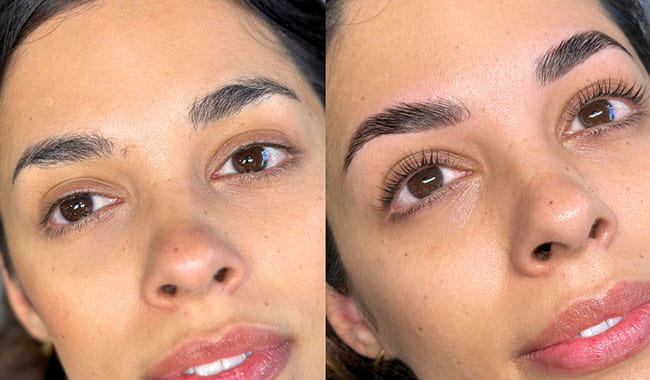
The beauty industry is constantly evolving, and lash lifting is no exception. One technique generating real interest among professional lash artists is the Korean Lash Lift — an advanced approach that gives artists greater control, particularly with downward-growing, coarse or resistant lashes.
But what actually makes the Korean technique different? It isn’t just the way the lashes are positioned — it’s the combination of technique, product chemistry, viscosity control and precise lash assessment. For artists using Elleebana systems, understanding how the Korean Lash Lift technique relates to CHC (cysteamine hydrochloride) is key to getting controlled, beautiful results.
CHC — cysteamine hydrochloride — is the active ingredient behind the Elleeplex Profusion system. Elleebana describes Profusion as a CHC-based system designed to gently restructure the hair while helping maintain its strength and integrity.
Here’s why that matters chemically: natural lashes hold internal bonds that give the hair its existing shape. During a lift, the first lotion softens and reduces these bonds so the hair can flex into a new position; the second lotion then sets that new shape. The active ingredient driving this process shapes how gentle or aggressive that whole process is — which is exactly why Elleebana’s education draws a clear line between CHC and TGA formulas rather than treating every lifting system the same way.
Elleebana’s One Shot system uses TGA, while Elleeplex Profusion uses CHC. According to Elleebana, TGA works faster and stronger, which is what drives One Shot’s rapid processing — while CHC works more gently, with a focus on preserving structural integrity within the hair.
This distinction becomes especially relevant for the Korean technique, which involves controlled lash placement and, depending on the application, methods like cling film and full root-to-tip saturation. Because of that, Elleebana doesn’t recommend One Shot for the Korean technique — Elleeplex Profusion, the CHC-based system, is the appropriate choice instead.
The lesson for professional artists: different chemistry requires different technique. A processing approach built for one chemical system shouldn’t simply be transferred to another.
Product control is just as central to the Korean technique as the chemistry behind it. A viscosity controller can thicken Step 1, helping the lotion stay exactly where the artist places it — giving more control when positioning stubborn lashes and reducing unwanted product migration. Elleebana treats viscosity control as an essential part of the Korean technique, especially useful for lashes that naturally fall downward or resist being repositioned upward.
Rather than relying purely on adhesive to hold every lash in place, the artist combines controlled viscosity with the right shield and application technique — resulting in a more deliberate, intentional approach to placement.
Even with a gentler CHC-based system, professional assessment doesn’t become optional. Two clients can have lashes that look similar but respond very differently to the same chemical treatment — thickness, natural growth direction, elasticity, previous chemical services, overall condition and client suitability all play a role.
This is why Elleebana’s Korean Lash Lift education puts real weight on consultation, contraindications, and flex and set checks — adapting the service to the individual rather than following a fixed script. Timing should be treated as part of ongoing professional observation, not just a number on a timer; a flex check helps confirm the lashes have reached the right flexibility before moving to the next stage.
The real strength of the Korean Lash Lift isn’t any single product or step — it’s chemistry and technique working together. Elleeplex Profusion provides the CHC-based foundation Elleebana identifies as compatible with Korean applications, while Elleemix Powder and viscosity control help artists dial in the product consistency this style of work demands.
For the professional artist, that reframes the whole question. Instead of “how do I make this lash curl?” it becomes “how do I understand this lash, choose the right chemistry, control the product, and create the desired direction safely and precisely?” That shift in thinking is what separates advanced lash artistry from simply following steps.
Worth noting: the Korean technique isn’t about speed. Elleebana notes it can actually take more time because of the precision involved in positioning individual lashes, particularly thick or coarse hair — but for clients with resistant or downward-growing lashes, that investment pays off in a more elevated base, cleaner direction and a genuinely open-eye effect.
Is CHC safer than TGA for lash lifting? “Safer” isn’t quite the right framing — both are established actives used in professional lash lifting. CHC works more gently and focuses on preserving the hair’s structural integrity, while TGA processes faster and stronger. The right choice depends on the technique and the individual lash, not one being universally better than the other.
Can I use One Shot for a Korean Lash Lift? Elleebana doesn’t recommend it. The Korean technique’s controlled placement and processing methods (like cling film and full root-to-tip saturation) are better suited to Elleeplex Profusion, the CHC-based system, rather than TGA-based One Shot.
Why does viscosity control matter so much for this technique? Because the Korean method relies on precise, controlled lash placement rather than adhesive alone. Thickening Step 1 with a viscosity controller helps the lotion stay exactly where it’s applied, which is especially useful for lashes that resist being repositioned upward.
Does a gentler, CHC-based system mean less assessment is needed? No — if anything, assessment matters just as much. Lash thickness, elasticity, growth direction, previous chemical treatments and overall condition still vary client to client, regardless of which chemistry is used.
Is the Korean Lash Lift technique faster than traditional methods? Not necessarily — it can actually take longer, since positioning individual lashes with precision (particularly thick or coarse hair) requires more careful, deliberate work than a standard lift.
Do I need special training to perform a Korean Lash Lift with CHC-based systems? Yes. Because the chemistry and technique are interdependent, Elleebana’s education covers consultation, contraindications, and flex and set checks specific to this approach — it isn’t something to improvise from a standard lash lift background alone.
Modern lash artistry has moved past just following a set of steps — the most successful professionals understand why each one matters. Korean Lash Lift technique shows this clearly: lash positioning, viscosity control, shield choice, and — critically — the chemistry of the lifting system all work together to shape the final result.
With CHC-based Elleeplex Profusion, Elleebana gives professional artists a system built specifically for Korean and other advanced lash-lifting techniques. When chemistry, education and technique come together, lash lifting stops being just a treatment — it becomes an art backed by science.
Understand the chemistry. Control the technique. Elevate the result.